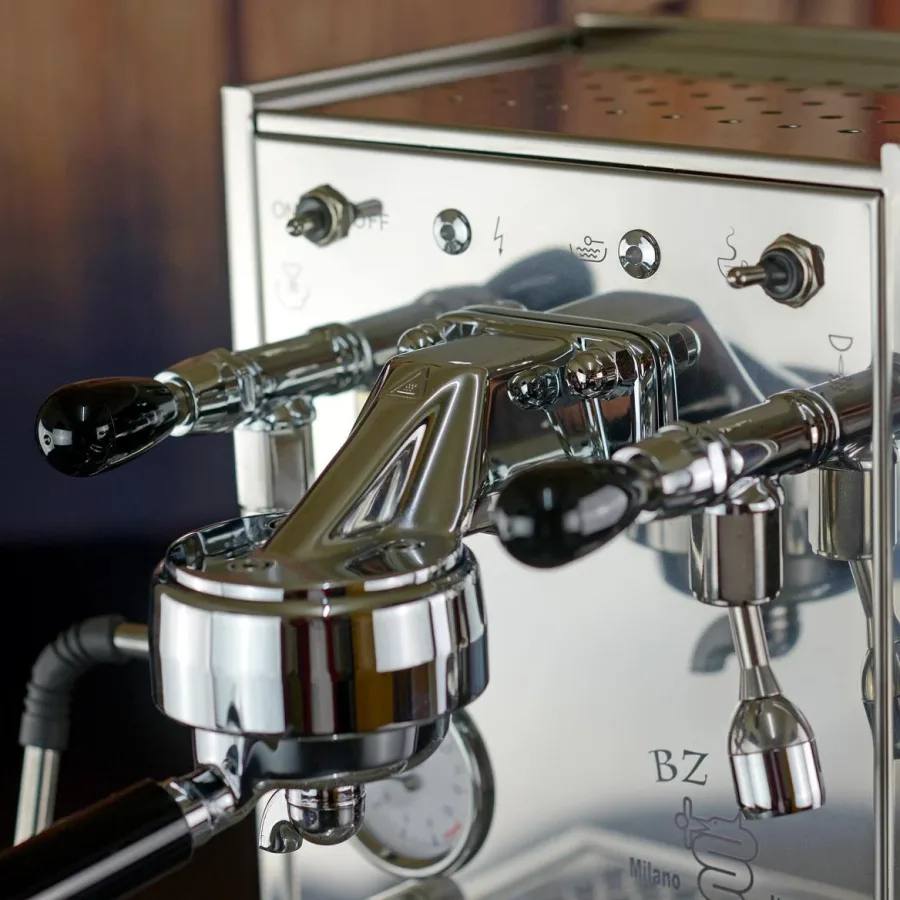
Heat-exchanger E61 entry prosumer machine.
Care schedule
5 tasks for this machine.
Purge and wipe the steam wand
DailyMilk that dries inside the tip cooks onto the steel and will not brush off later. A wand cleaned within seconds of use stays clean indefinitely; one cleaned tomorrow needs soaking.
What you need
- A damp cloth kept only for the wand. A pin or the tip key for the holes. Milk-system detergent such as Rinza or Puly Milk for the weekly soak.
What goes wrong
- Wiping without purging, so milk stays inside the tip and sours. Letting the wand cool before wiping. Opening the tip holes out with a drill bit or a thick needle, which permanently ruins the steam pattern. Using the same cloth for the wand and the drip tray.
The procedure
- Purge the wand for two seconds immediately after steaming, before you pour the milk. That clears whatever got sucked back up into the tip.
4 more steps
The rest is in the app, with a reminder when it is next due.
Get the appBackflush the group
WeeklyThe three-way valve lets you push water backwards through the shower screen and out to the drain, which is the only way to clear the oil and grounds that collect behind it. Neglect it and every shot picks up a stale, ashy edge no matter how good the coffee is.
What you need
- A blind, or blank, basket for your portafilter and a coffee detergent such as Cafiza or Puly Caff. About 3g of powder - a level scoop, not a heaped one.
What goes wrong
- Backflushing a machine with no three-way valve. Overdosing the detergent. Stopping after the detergent stage, so the next four shots taste of soap. Never brushing the screen, so the detergent lifts the oil and it settles straight back onto it.
The procedure
- Confirm your machine has a three-way solenoid valve. If running the pump with a blind basket makes water hiss out of the drain box, it does. Lever machines and most thermoblock machines do not, and forcing it pressurises the pump against a closed circuit.
5 more steps
The rest is in the app, with a reminder when it is next due.
Get the appClean the shower screen
MonthlyThe screen and the recess above it hold a film of coffee oil that no amount of shot-pulling shifts. It is the most common reason a well-dialled machine slowly starts tasting muddy.
What you need
- A screwdriver or hex key for the screen bolt, a soft brush, and Cafiza or Puly Caff for the soak. A group brush for the underside.
What goes wrong
- Working on a hot group and burning a hand. Overtightening the bolt and dishing the screen. Soaking and refitting without brushing the recess, so the oil is still there. Losing track of the dispersion block's orientation.
The procedure
- Work with the machine off and the group cool enough to touch. The screen bolt sits directly over a hot boiler.
5 more steps
The rest is in the app, with a reminder when it is next due.
Get the appDescale the boiler
Every 3 monthsScale on the boiler wall and in the group's water path drops brew temperature, blocks the steam tip, and eventually coats the temperature probe so the machine no longer knows how hot it is. On a tank machine this is the maintenance that decides whether it lasts five years or fifteen.
What you need
- Citric acid powder, about 15g per litre, or a proprietary espresso descaler. A vessel to catch the output. Your machine's manual - the sequence differs per boiler layout.
What goes wrong
- Descaling hot, which etches brass. Mixing the solution as strong as a kettle descale. Flushing once and then pulling a shot that tastes of lemons. Ignoring the steam path, so the wand stays blocked and the boiler probe stays coated. Using vinegar in a machine whose maker forbids it - most espresso makers do.
The procedure
- Read the maker's descaling section first. Single-boiler, heat-exchanger and dual-boiler machines each need a different sequence, and some makers require a technician instead.
5 more steps
The rest is in the app, with a reminder when it is next due.
Get the appReplace the group gasket
YearlyThe group gasket hardens and compresses with heat. A dead one leaks around the portafilter, makes the handle sit further and further clockwise, and lets pressure escape that should be going through the puck.
What you need
- The correct gasket for your group - 8mm or 8.5mm thickness for an E61, model-specific elsewhere. A gasket removal tool or a corkscrew. Food-safe silicone grease, optional.
What goes wrong
- Choosing thickness by guess instead of measuring the old one. Scarring the group seat with a screwdriver. Leaving fragments of the old gasket in the seat. Replacing on a schedule while ignoring the handle position, which is the actual indicator.
The procedure
- Confirm the diagnosis first. A gasket is finished when the portafilter handle has crept well past its original position, or when water weeps from the group during a shot.
5 more steps
The rest is in the app, with a reminder when it is next due.
Get the app